A used golf cart may look polished while hiding a weak battery pack. Battery condition directly affects range, hill-climbing ability, charging time, and resale value. The U.S. Department of Energy explains that battery performance changes with age, temperature, charging habits, and operating conditions. Those factors matter in golf carts, especially when several lead-acid batteries work together as one system.
How to check golf cart battery health begins with service records and a careful visual inspection. Look for swollen cases, cracked terminals, corrosion, leaking electrolyte, or uneven water levels. A fully charged pack should also show balanced voltage between individual batteries. However, voltage alone can mislead. A tired battery may display normal voltage immediately after charging, then collapse under load. A professional load test, hydrometer test for flooded batteries, and charger-output check provide stronger evidence. Lithium-ion systems need different diagnostic procedures, including battery-management-system readings.
Industry guidance supports a cautious approach. Battery Council International identifies maintenance, correct charging, and recycling as central factors in lead-battery performance. IEEE Recommended Practice 1188 also stresses temperature control, charging management, and capacity testing for stationary lead-acid batteries. These are not golf-cart-specific rules, but they offer useful technical context. Manufacturers such as Trojan Battery and Club Car publish model-specific testing and maintenance instructions, which should take priority.
A small mistake can become an expensive replacement. I once underestimated corrosion because the terminals looked only slightly dirty. That assumption was wrong. Buyers should test the cart after charging, record pack voltage, and compare results with the manufacturer’s specifications. A careful inspection may feel slow, but it can reveal the difference between a dependable cart and a costly project.
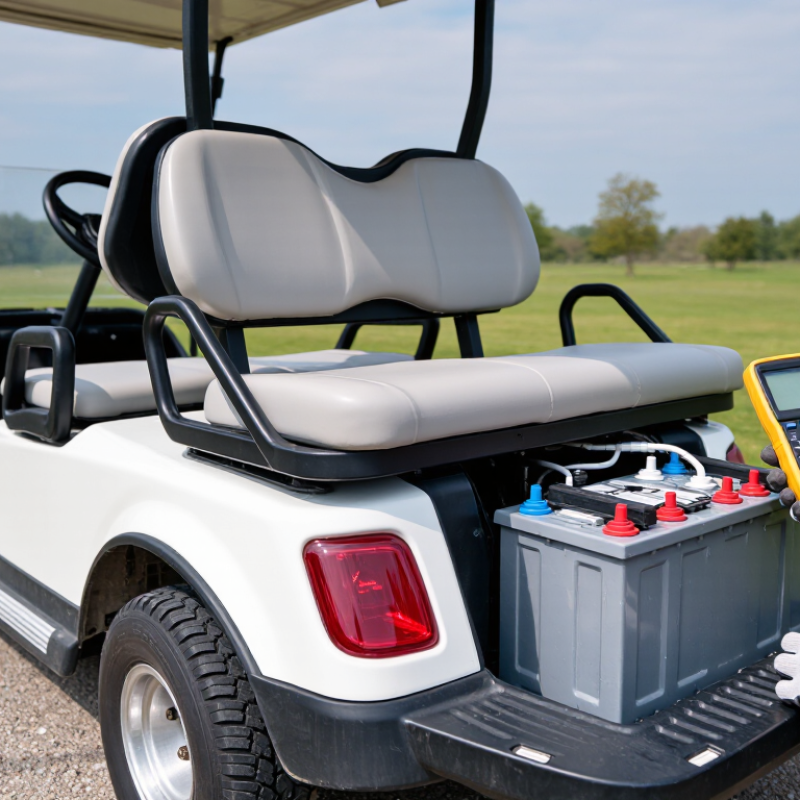
A golf cart can look clean while its batteries are close to failure. Identify the battery type first: flooded lead-acid, AGM, or lithium. Each type requires different charging habits, maintenance, and testing methods. Check the voltage system carefully, such as 36, 48, or 72 volts. A mismatched battery pack can damage the charger or reduce driving performance. Use a multimeter, then compare each battery’s reading with the manufacturer’s specifications. Do not trust the dashboard alone.
Age matters more than many buyers expect. Look for a production date, service label, or purchase record. Battery age is often measured from manufacturing, not installation. Also ask how frequently the cart was driven and stored. A lightly used battery may still suffer from heat, deep discharge, or long periods without charging. I once judged a pack by its clean appearance and missed uneven voltage between cells. That mistake could have been expensive.
Tips: Ask for the rated cycle life and the conditions behind that rating. Cycle life is not a guaranteed distance or ownership period. Review the warranty, charging history, and recent load-test results. For lithium batteries, request battery-management-system information when available. For lead-acid batteries, inspect fluid levels, corrosion, swollen cases, and cracked terminals. Test it under load. A strong resting voltage can hide weak capacity. If records are missing, price the cart as if replacement may be soon.
A clean cart can hide weak batteries. Test voltage, charging behavior, and performance under load. A short uphill drive may reveal problems that a flat road misses. I once trusted appearance and missed uneven cell voltage. That was an expensive oversight.
Check whether the pack uses flooded lead-acid, AGM, or lithium batteries. Each type has different charging and maintenance needs. Read the battery labels and inspect the charger. Do not rely only on the dashboard. The chemistry matters.
Confirm whether the cart uses a 36, 48, or 72-volt system. Then check each battery’s rating and connection pattern. Common individual ratings include 6V, 8V, and 12V. A battery that fits physically may still be electrically wrong. Measure carefully.
After several hours of rest, fully charged batteries often read near 6.3V, 8.4V, or 12.6V. These figures depend on the battery’s rating and condition. Lower readings may indicate deep discharge, sulfation, or a weak cell. Use a calibrated digital multimeter. Numbers can mislead.
Battery age usually begins at manufacturing, not installation. Look for date codes, service labels, or purchase records. Ask how often the cart was driven and stored. Heat, deep discharge, and long storage can shorten battery life. A lightly used battery is not automatically healthy.
Lead-acid batteries commonly last about 4–6 years with consistent care. Lithium batteries commonly last about 8–10 years under suitable conditions. These are practical ranges, not promises. Heat and repeated deep discharges can reduce either lifespan. The figures need context.
A strong resting voltage can hide weak capacity. Test the cart while accelerating, climbing, or carrying normal weight. Watch for sharp voltage drops, slow acceleration, or unusually long charging. One weak battery can affect the entire series pack. This test is imperfect, but useful.
Ask for the battery age, charging history, warranty details, and recent load-test results. Request rated cycle life and the conditions behind that rating. For lithium batteries, ask for available battery-management information. For lead-acid batteries, inspect fluid levels, corrosion, swollen cases, and cracked terminals. Missing records matter.
Treat unclear records as a possible near-term replacement cost. Compare the battery’s age, chemistry, performance, and replacement price. A smooth test drive does not prove long-term capacity. I would pay less when measured evidence is missing. That may be overly cautious.
How to check golf cart battery health before buying starts with identifying the battery type, voltage, age, and rated cycle life. Confirm whether the system uses 6V, 8V, or 12V batteries, and compare the ratings with the golf cart’s original equipment specifications. For flooded lead-acid batteries, inspect the cells and measure the specific gravity, which should generally fall between 1.275 and 1.280 according to BCI guidance when fully charged. Also check for corrosion, swelling, leaks, or damaged terminals.
A proper load test is essential because voltage alone may not reveal a weak battery. Test each battery for the manufacturer’s specified 15-second limit and compare the results across the entire set. Finally, consider battery age and expected service life: lead-acid batteries typically last about 4–6 years, while lithium batteries may provide approximately 8–10 years under suitable conditions. These checks can help buyers estimate replacement costs and avoid purchasing a golf cart with unreliable or prematurely aging batteries.

 E-par Golf Cart