Buying a used golf cart in China can look simple: check the paint, test the lights, and take a short ride. Yet a clean body can hide weak batteries, corroded terminals, or a tired motor. So, What should I inspect before buying a used golf cart? Start with its service history, battery age, charging system, brakes, steering, tires, and frame. Ask for maintenance records, not just a seller’s verbal assurance. Take your time.
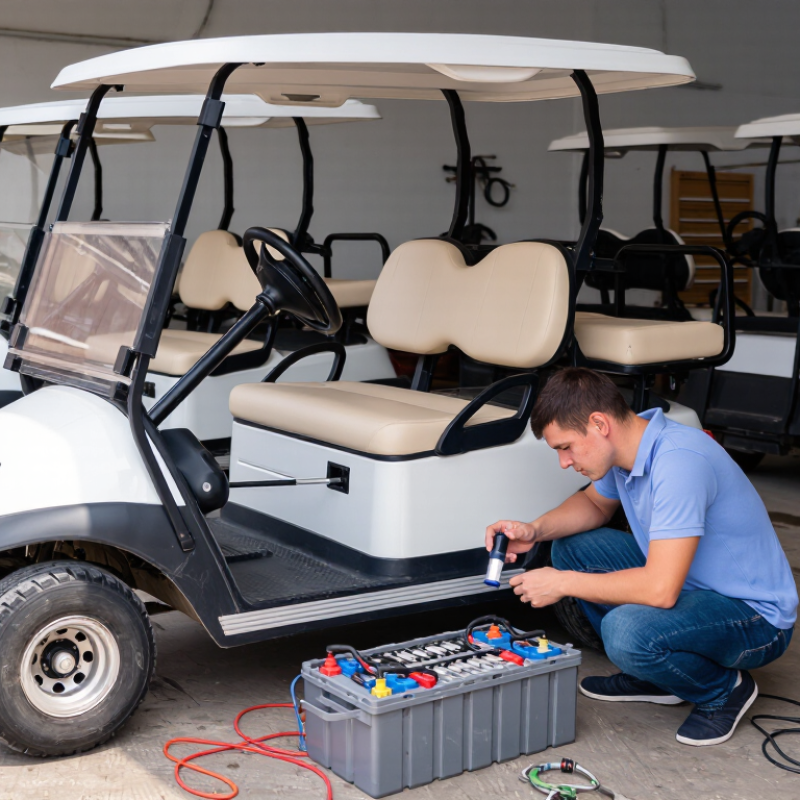
Battery condition deserves close attention. Look for swollen cases, loose cables, white or green corrosion, and uneven voltage readings. During a test drive, listen for grinding, watch for sluggish starts, and check whether the cart pulls to one side. Test the brakes on level ground. Inspect beneath the chassis for rust, fresh repairs, or fluid leaks. Small details matter.
A qualified golf-cart technician can assess battery health and drivetrain wear more reliably than a quick parking-lot check. I can’t verify a named expert’s published statement from the information provided, so I won’t invent a quotation. A practical inspection rule is: “A smooth test drive is useful, but it does not replace a battery and mechanical check.” That distinction can save buyers from expensive surprises. It is not a guarantee. Models, parts, and service support vary across China, so confirm that replacement components are available locally. Compare the cart’s condition with its asking price, and budget for repairs. A few scratches may be harmless. Weak batteries are not.
Before judging condition, define the cart’s type and intended use. Is it electric or fuel-powered, passenger-focused or built for carrying equipment? Check the identification plate for the model year and serial number, then compare those details with maintenance records. A replacement body or fresh paint can make an older cart look newer than it is. Small detail, big difference.
Use GB/T 21268-2014 as a safety reference when reviewing a golf cart’s design and documentation. Ask the seller which version and configuration the cart was built to meet, and request supporting records where available. The standard is a useful baseline, not proof that a used cart is currently safe. Inspect brakes, steering play, tires, lights, and battery condition in person. Test it on level ground and listen for uneven motor or drivetrain noise. A clean body can still hide tired brakes. Paperwork is not the cart.
Tips: Photograph the ID plate, note the model year, and match both against the seller’s records. Check for corrosion around battery connections and cracks near the frame. If a detail does not add up, pause and ask for clarification; even careful buyers can miss something.
A used golf cart may look ready to drive, yet its battery system can tell a different story. Confirm whether it uses 36 volts or 48 volts before checking anything else. The voltage is usually shown on the charger or vehicle label. Check the label. Do not guess from the number of batteries: configurations vary, and a 48-volt pack may contain different battery sizes. A mismatched charger can cause poor charging or damage, so confirm that the charger matches the cart’s system.
Inspect every battery, not just the cleanest one. Look for cracked cases, swelling, leaks, corroded terminals, loose cables, and unreadable date codes. For flooded lead-acid batteries, check fluid levels and use a suitable hydrometer; keep sparks away and wear eye protection.
A voltage reading alone is not enough. Ask for a load test or have a technician test each battery, because one weak unit can reduce the whole cart’s range. If the cart uses lithium batteries, request a battery-management-system report and ask about service history.
This may seem overly cautious, but a tidy dashboard can hide uneven battery wear. Even careful checks have limits. If the seller cannot verify the system or provide clear test results, budget for a professional inspection before buying.
When evaluating a used golf cart from China, inspect safety-critical parts before judging paint or accessories. Park it on level ground, switch it off, and use a flashlight. Look along the frame for cracks, fresh welds, deep rust, or bent sections. Fresh coating may hide repairs. Do not ignore uneven weld beads. Check battery mounts and floor supports for movement. A loose frame can make every other test misleading.
Test the brakes at walking speed on a clear, private surface. The pedal should feel firm, and the cart should stop without pulling sideways. Inspect cables, drums, pads, and hydraulic lines for wear or leaks. Turn the steering wheel gently from lock to lock. Excessive play, grinding, or delayed response needs professional attention. Check each tire for cracks, bald edges, bulges, and uneven wear. Measure tread depth consistently, not only on the best-looking tire.
The charger deserves equal scrutiny. Verify its plug, casing, cooling vents, and cable insulation. Connect it only in a dry, ventilated area, and watch for heat or unusual noise. Confirm that charging begins normally and stops as expected. Ask for battery age, charging history, and maintenance records. A short test drive can miss faults. I would record photos and readings, then request an independent technician’s opinion. No inspection is perfect, especially when records are incomplete. That uncertainty should affect the price and purchase decision.
A test drive should resemble the trips the cart will actually make. Drive it on flat pavement, then try a gentle hill and several stop-and-go turns. Notice whether acceleration feels steady, braking pulls to one side, or steering vibrates. Listen closely. A clunk over bumps or a delayed response can point to wear that a quick parking-lot loop may miss. Carry a passenger or modest load if that matches typical use, and note how performance changes. Tire pressure and surface conditions affect results, so record them rather than treating one drive as definitive.
Charging and range deserve the same careful check. Ask for a full charge, then confirm that the charger connects securely and does not become unusually hot or produce a burning smell. Check cables and terminals for corrosion or loose connections. After charging, drive a repeatable route that includes hills and frequent stops, and track distance alongside the battery display. That gauge can be optimistic. Temperature, load, terrain, and battery age all influence range, so avoid judging the cart from a single reading. If possible, repeat the route on another day; imperfect test conditions are easy to overlook, and that uncertainty matters.
| Inspection Area | How to Check | Realistic Guidance | Warning Signs |
|---|---|---|---|
| Battery type and condition | Confirm whether the cart uses lead-acid or lithium batteries. Check the battery labels, installation date, terminals, cables, and any available service records. | Battery voltage, capacity, age, and condition affect both performance and range. Compare readings with the battery maker’s specifications and have a technician test the pack under load. | Corrosion, swollen cases, leaks, loose cables, mixed battery ages, or a rapid voltage drop during acceleration. |
| Initial battery charge | Start with a fully charged cart. Record the displayed charge and, if possible, have battery voltage checked after the cart has rested. | A dashboard gauge is an estimate, not a precise battery-health test. Battery readings should be interpreted according to battery chemistry and the manufacturer’s specifications. | The charge indicator drops sharply as soon as the cart is driven or behaves inconsistently between starts. |
| Acceleration and throttle response | On a clear, level route, accelerate smoothly from a stop several times. Check forward and reverse operation without abrupt throttle inputs. | Acceleration should be predictable and reasonably consistent. Performance varies with motor, controller, battery condition, passenger load, and vehicle configuration. | Hesitation, surging, unusual electrical noises, burning smells, or markedly weaker acceleration as the test continues. |
| Speed and braking | Use a safe, level area to verify that the cart accelerates and slows smoothly. Test the service brake and parking brake at low speed. | Compare maximum speed with the cart’s documentation and intended use. Speed limits and requirements may differ by location and vehicle classification; do not assume a golf cart is road-legal. | Brake pulling, grinding, excessive pedal travel, weak stopping, a parking brake that will not hold, or speed inconsistent with the seller’s description. |
| Hill and loaded performance | If safe and permitted, drive a gentle incline and repeat with a realistic passenger or cargo load. Avoid steep slopes and overloading. | Uphill driving and added weight increase energy use and can reduce range. Compare performance using the cart’s rated capacity and the conditions in which it will be used. | Severe slowing on a mild incline, repeated power cut-outs, excessive motor or controller heat, or difficulty restarting uphill. |
| Charging equipment and connection | Inspect the charger, plug, cable, socket, and charging port. Confirm that the charger is intended for the cart’s battery chemistry and voltage. | Use a compatible charger and a properly grounded, correctly rated power supply. Follow the charger and battery instructions; charging time depends on pack size, charger output, and starting charge. | Cracked insulation, scorched pins, improvised wiring, a loose connection, or a charger that becomes unusually hot or repeatedly stops. |
| Full charging cycle | If possible, observe a charging session from connection to completion and check the charger’s status indicators. Ask for records of recent charging or battery service. | Charging time is not a universal pass/fail measure. Lead-acid and lithium packs use different charging profiles; compare the observed cycle with the correct manufacturer guidance. | The charger never reaches its normal completion state, the battery charge remains low after charging, or charging repeatedly cuts out. |
| Real-world range test | Begin fully charged and drive a measured route that includes stops, turns, moderate inclines, and the expected passenger or cargo load. Record distance and charge before and after. | Range varies substantially with battery age, temperature, speed, terrain, tire pressure, payload, and driving style. A short test cannot establish full-charge range; use a longer controlled test when range is critical. | A large charge drop over a short, easy route or range claims that cannot be supported by a measured test under comparable conditions. |
| Tires, steering, and wheel alignment | Check tire pressure against the specified value, inspect tread and sidewalls, and drive slowly on a flat surface to feel for pulling or excessive steering play. | Uneven pressure, worn tires, and alignment problems can affect handling, safety, and energy consumption. Inspect all tires, including the spare if supplied. | Cracks, exposed cords, uneven wear, vibration, loose steering, or the cart drifting on a level surface. |
| Post-drive inspection | After the test, check for unusual odors, fluid or electrolyte leaks where applicable, hot connectors, loose components, and new warning indicators. | Some faults become apparent only after the motor, controller, brakes, or batteries have been used. Let hot components cool before touching or inspecting them closely. | Burning or sulfur-like odor, smoke, leaking fluid, melted wiring, abnormal heat, or a new fault warning. |
Note: Use the vehicle and battery documentation as the primary reference. Test results are affected by battery chemistry, configuration, temperature, route, terrain, and load; have a qualified technician inspect safety-critical or electrical faults.
Before buying a used golf cart in China, ask for dated service records, not a verbal promise. Look for battery chemistry, replacement dates, charger repairs, and measured pack voltage under load. A battery that looks clean may still sag on a slope. Small details matter. Ask a technician to inspect brakes, steering play, tire cracking, and wiring corrosion. The Ministry of Industry and Information Technology reported China’s lithium-ion battery industry output exceeded 940 GWh in 2023, up 25% year on year. That figure describes the wider battery sector, not golf-cart parts availability, so confirm the exact battery type, voltage, connector, and controller part numbers with local suppliers.
Availability can vary by cart configuration and city. Before paying, request written prices and delivery estimates for common wear items, especially batteries, tires, brake components, and chargers. A low purchase price is less useful if a small replacement part leaves the cart idle for weeks. I would not assume a widely produced battery means a compatible pack is nearby. That assumption deserves checking. For local use, verify site access and applicable requirements with the golf course or local authorities. China’s GB/T 21268-2014 standard addresses golf-car safety requirements; meeting a safety standard alone does not establish permission to use a cart on public roads. Confirm the current standard edition and local rules before relying on the seller’s claims.
Approximate resting voltages for a 12 V lead-acid battery, measured after it has rested and at around 25°C. A low reading can signal a need for further battery testing; readings vary with battery condition and type. Before buying, also verify dated service records, confirm replacement parts are available locally, and check the rules in the intended area—golf-cart road access and operating requirements can vary by locality.
Check its identification plate for the model year and serial number. Compare them with service records. Fresh paint can disguise an older cart.
Check the brakes, steering play, tires, lights, battery connections, and frame for cracks or corrosion. A clean body proves little.
It provides a safety reference for golf-cart design and documentation. It does not prove that a used cart is safe today.
Ask for the battery chemistry, replacement date, charger repairs, and voltage measured under load. A battery may look clean but weaken on a slope.
Confirm the battery type, voltage, connector, and controller part numbers with local suppliers. Request written prices and delivery estimates.
Check the cost and availability of batteries, tires, brake components, and chargers. A small missing part can leave the cart idle for weeks.
Drive on level ground and listen for uneven motor or drivetrain noise. Notice how the brakes and steering respond. I could still miss a hidden fault.
Do not assume that meeting a safety standard permits road use. Check current local requirements and access rules with the relevant authorities or site.
Buying a used golf cart in China starts with identifying its type, model year, intended use, and relevant GB/T 21268-2014 safety considerations. What should I inspect before buying a used golf cart? Begin with the battery system: confirm whether it is 36 V or 48 V, check each battery for visible damage or corrosion, and ask about its age, maintenance, and replacement history. Then examine the frame, brakes, steering, tires, and charger for wear or faults, making sure the cart appears stable and the safety equipment works properly.
A realistic test drive can reveal weak acceleration, unusual noises, steering problems, or inconsistent braking. Test charging as well, and assess the cart’s practical range under conditions similar to your expected use. Before making a decision, review service records, confirm that replacement parts and repairs are accessible locally, and check the rules that apply to using the cart in your area. These steps help you judge its condition and suitability rather than relying on appearance alone.

E-par Golf Cart